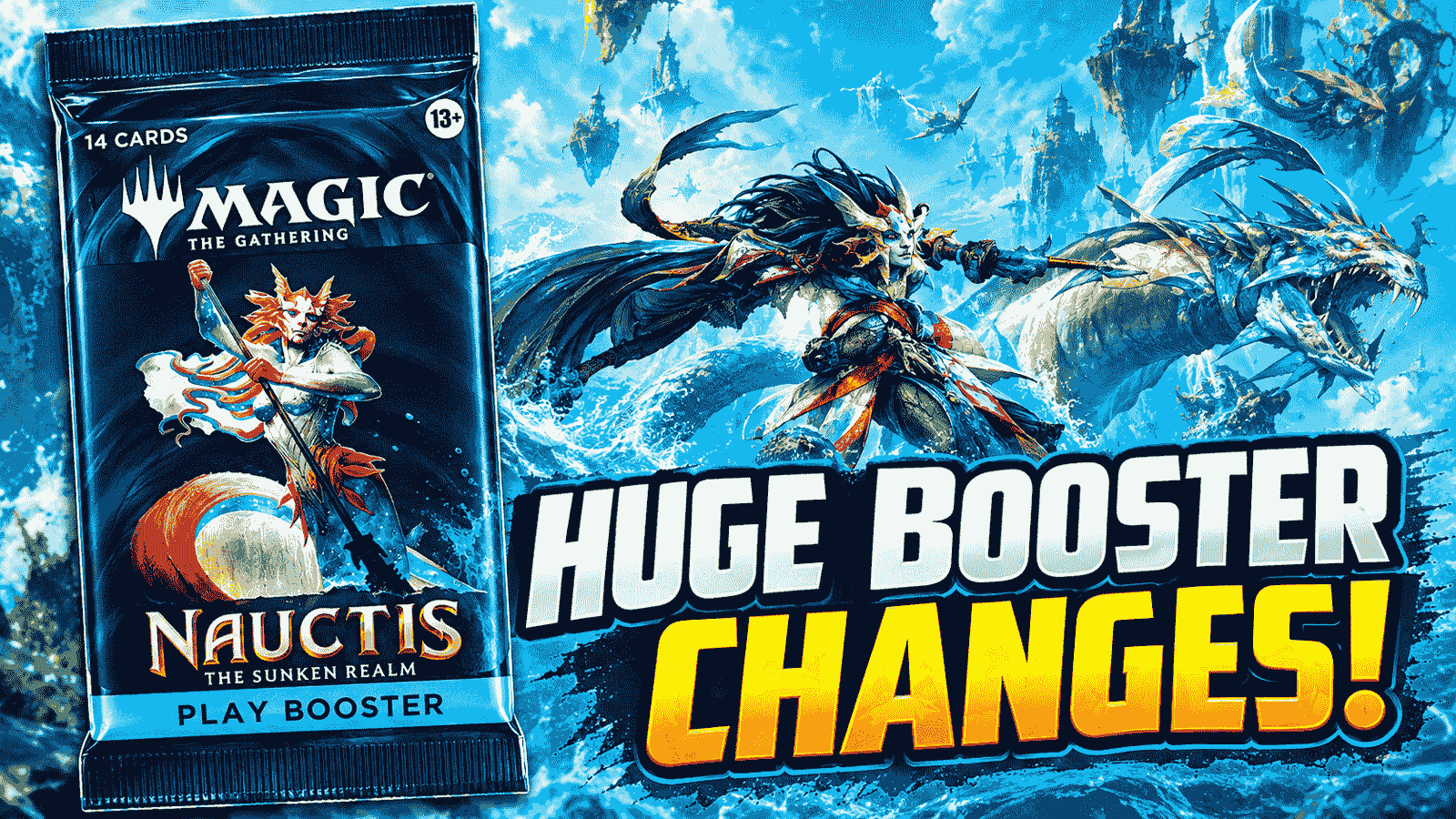

Wizards of the Coast has just confirmed one of the bigger structural changes to hit Magic: The Gathering’s physical product line in years. Starting with Nauctis: The Sunken Realm, the first set of 2027, booster packs are getting rebuilt from the inside out — new premium pull formats, a rebrand for one of the product lines, and the removal of several card types that have sat in boosters for over a decade. Here’s everything changing, and why Wizards says none of it will cost you more at checkout.
The Question Driving All Of This
According to Wizards, the entire overhaul traces back to one guiding question the design team kept returning to: what actually makes opening a booster exciting? It’s a deceptively simple thing to ask, but the company says sitting with it long enough forced a genuine reassessment of what’s inside every pack. Some contents, they admit, have stuck around simply because they’ve always been there — not because players still find them thrilling to pull. Others served a purpose once, but that purpose has quietly faded with time.
That reassessment is what’s driving this entire round of changes, and Wizards has been upfront that the goal cuts both ways — adding things players genuinely get excited to open, while cutting things that have become afterthoughts.
The Headline Addition: God Packs
The single biggest change here is the introduction of God Packs, a new ultra-rare pull format coming to every Magic Multiverse set starting with Nauctis: The Sunken Realm. The concept is about as straightforward as its name suggests — a God Pack is a booster where every single nonbasic card inside is a rare or mythic rare, with zero commons or uncommons diluting the pull.
In standard Booster Packs, the odds are set at 1 in every 1,000 packs, and a God Pack pull nets you:
- 1 God Pack celebration card
- 10 non-foil rare and/or mythic rare cards
- 2 non-foil Booster Fun rare and/or mythic rare cards
- 2 traditional foil Booster Fun rare and/or mythic rare cards
That’s 14 rare-or-better cards in a single pack, pulled from a product that normally gives you a small handful of commons and uncommons alongside your usual rare slot. Wizards didn’t hold back on how it expects players to react either, saying outright that it expects the first person to open one to “briefly lose their mind” — and that the company is fully on board with that reaction.
Collector Boosters Get An Even Bigger Version
If a standard God Pack sounds exciting, the Collector Booster version pushes things further. Set at odds of 1 in every 300 Collector Boosters, this premium pull includes:
- 1 God Pack celebration card
- 1 foil land
- 3 foil default frame rare and/or mythic rare cards
- 3 non-foil Booster Fun rare and/or mythic rare cards
- 5 foil Booster Fun rare and/or mythic rare cards
That last slot is the one worth paying attention to. Wizards describes it as five copies of what players have come to know from WeeklyMTG broadcasts as the “foil fancy slot” — a premium card slot that, pulled five times over in a single pack, carries a genuine, if unlikely, chance of landing multiple headliner cards in one single booster. Wizards is quick to call that outcome improbable, but doesn’t rule it out either.
Japan Showcase Cards Are Leaving Collector Boosters’ Exclusive Club
Beyond the God Pack system, Wizards is also loosening up access to one of its most visually distinctive card treatments. Japan Showcase cards — a premium art style that’s previously been locked exclusively inside Collector Boosters — will now be crackable directly from the wildcard slot in standard Booster Packs, printed in traditional foil.
Paired with that change, Wizards is also bumping up the overall drop rate for foil rare and mythic rare cards across standard Booster Packs. Combined, both changes are aimed at the same outcome: making a regular pack-opening session feel like it carries noticeably better odds of landing something worth getting excited about, rather than the god-tier pulls being locked entirely behind the rare 1-in-1,000 God Pack odds.
A Name Change, Too
Amid all the structural changes, there’s a simpler rebrand buried in the announcement: Play Boosters are now just called Booster Packs. Wizards’ own explanation for the switch is about as plain as it gets — cleaner, simpler, and easier to type. It’s a small housekeeping change relative to everything else in this announcement, but worth knowing if you’re used to the old terminology and suddenly see packaging referring to something slightly different.
What’s Being Removed
Every addition in this update needed room to exist somewhere, and Wizards was fairly candid about where that space is coming from.
Foil common and uncommon cards are being removed from standard Booster Packs entirely, and Wizards is no longer guaranteeing a foil card of any kind in every pack. If you do pull a foil in a standard Booster Pack going forward, it’ll be a rare or mythic rare — never a common or uncommon. Wizards points to consistent player feedback suggesting foil commons and uncommons had largely lost their appeal, with the increased foil rare/mythic drop rate mentioned earlier intended to help offset that change.
Collector Boosters are losing cards too — specifically two commons and one uncommon from their foil slots, with no replacements going in to fill that gap. Wizards’ reasoning here is unusually blunt: removing these cards doesn’t make Collector Boosters more exciting to open, and the company says so directly. What it does do is reflect how players were actually engaging with that part of the product already. According to Wizards, most Collector Booster unboxing videos skip straight past the common and uncommon foil section, since the majority of openers simply weren’t excited by what landed there. A smaller number of foil commons and uncommons will still exist in Collector Boosters, since they won’t be available in standard Booster Packs at all, but the overall count is shrinking.
The Trade-Off Wizards Is Admitting To
What makes this announcement notably candid is that Wizards doesn’t try to spin the removals as secretly exciting. Instead, the company frames it plainly as a capacity trade-off — booster printing has gotten more complex, and adding God Packs and Japan Showcase access to standard packs required finding room somewhere else in the production pipeline. The commons and uncommons being cut were, in Wizards’ own words, both unlikely to be missed and sufficient to free up the capacity needed to make the bigger additions possible.
It’s a rare moment of a company openly saying “we’re cutting the boring part to make room for the exciting part” rather than dressing up a removal as an improvement on its own.
No Price Increase, According To Wizards
Perhaps the most immediately relevant detail for regular buyers: Wizards states explicitly that none of these changes come with any price adjustments. The stated goal throughout the announcement was making boosters more exciting to open without touching the MSRP — meaning, at least according to the company’s own framing, you’re getting better odds and new pull types at the same price point you were already paying.
What This Means Starting With Nauctis: The Sunken Realm
All of these changes take effect with Nauctis: The Sunken Realm, the first Magic set of 2027, and will continue across every subsequent Magic Multiverse set going forward. Universes Beyond crossover sets — the line covering collaborations with other franchises — aren’t included in this initial rollout, with Wizards indicating that line is expected to adopt the same changes starting in 2028.
Taken as a whole, this is one of the more significant shake-ups to Magic’s physical product structure in recent memory — not just a new chase card or a seasonal promotion, but a genuine restructuring of what every single pack, common or premium, is built to contain. Whether you’re a Draft regular cracking packs every week or someone who only buys the occasional Collector Booster for a favorite set, the contents of what you’re opening starting next year are going to look meaningfully different from what’s shipping right now.